Monday, 21 April 2008

French ant collections

This list of ants in my collection was the result of a two week 'holiday' in the Dordogne and Massif Central areas of France. It was the first time I had ever collected ants outside of the UK and forecast the end of 'normal' holidays for me!

More information on the ants of France can be found at Fourmis, the French ant forum.

Dolichoderinae
     Dolichoderus
          quadripunctatus
     Tapinoma
          erraticum
Formicinae
     Camponotus
          aethiops
          cruentatus
          fallax
          gestroi 1
          lateralis
          ligniperda
          piceus
          trunctatus
          vagus
     Cataglyphis
          cursor
     Formica
          fusca
          gagates
          pratensis
          rufa
          rufibarbis
     Lasius
          alienus
          brunneus
          emaginatus
          flavus
          fuliginosus
          grandis 2
          niger
          platythorax
          psammophilus
     Plagiolepis
          pygmaea
Myrmicinae
     Crematogaster
          scutellaris
     Messor
          structor
     Myrmica
          sabuleti
          scabrinodis
     Pheidole
          megacephala 3
          pallidula
     Temnothorax
          grouvellei
          nylanderi
          racovitzai
          unifasciatus
     Tetramorium
          caespitum


1 Two alate queens, one found in the Salignac-Eyvigues, Dordogne, the other on Causse Noir in the Massif Central. The latter was found in association with C. lateralis. This species is not supposed to occur in mainland France, but after a lot of debate they were eventually confirmed by Cedric Collingwood.
2 A rarely recorded species in France. This collection was from the edge of a woodland near Nant, Massif Central. This has also been confirmed by Cedric Collingwood and matches the morphometrics given in Seifert (1992).
3 An introduced species in France, found alongside P. pallidula on the château walls at Castelnaud, Dordogne.

Sunday, 20 April 2008

UK ant collections

The other day I had a request from Professor James K. Wetterer at Florida Atlantic University. He had seen the invasive species listed as present in The Gambia and wanted further details of those and others that I had collected.

This lead to two surprises. The first was that someone was paying attention and cared what I get up to. The second was the large number of invasive ants I have collected, despite few collection forays outside of the UK. It has, however, made me wonder if it's worth highlighting the other species that I have in my collection or have records for, in case they are of use to anyone.

I've decided to kick this off with the shortest and simplest list: the paltry fauna of the UK (I'm going to upset some British myrmecologists with this description, but it doesn't make it any less true). A complete list of the 67 native and regularly recorded introduced ants can be found in the checklist available on the BWARS website. The few species that I have in my collection are listed below.

Formicidae
     Formica
          cunicularia
          fusca
          lemani
          lugubris
          picea 1
          rufa
     Lasius
          brunneus
          flavus
          fuliginosus
          niger
          platythorax
          psammophilus
          umbratus
Myrmicinae
     Formicoxenus
          nitidulus 2
     Leptothorax
          acervorum
     Myrmecina
          graminicola
     Myrmica
          lobicornis
          rubra
          ruginodis
          sabuleti
          scabrinodis
          schencki
          sulcinodis
     Technomyrmex
          albipes 3
     Temnothorax
          nylanderi
     Tetramorium
          caespitum


1 Alate queen collected in Yorkshire. Despite a lot of searching no colonies have been located in the area.
2 Two males collected by David Baldock.
3 Present only as a rare introduction, these specimens from the Eden Project.

Saturday, 19 April 2008

Hitting the big time

Whoa! Just browsing the other ant blogs and newsgroups and discovered that this blog is now linked from Myrmecos Blog!

Tapinoma simrothi subsp. festae

It was two months ago that I posted this image claiming it to be Tapinoma ambiguum. I was wrong - but that is nothing new!

Shortly after posting it I took the specimen to Cedric Collingwood, who glanced at it under a microscope and said 'Ah, it's festae!' Since then I've been planning to update this blog with a proper correction, but I wanted to be sure that I know why it is this species.

Why did it take so long? Basically, there is almost no information available on Tapinoma simrothi subsp. festae. It was described by Emery (1925), which I haven't been able to get hold of. I can find nothing else relating to it, aside from a mention in unchecked taxa in Agosti & Collingwood (1987). This entry has a question mark next to it, says that it's expected for the Balkan peninsula and the species is not featured in the key that followed.

Since I haven't encountered anything that clarifies the situation in the last two months, and forgot to ask Collingwood about it last time we spoke, I'm basing my acceptance of this identification on the fact that it is much larger than T. erraticum. T. ambiguum should be the same size as T. erraticum.

As far as I can make out, the size distiguishes T. simrothi from T. ambiguum and T. erraticum. T. simrothi subsp. festae is then distinguished by the shallow anteromedian clypeal notch, which is deeper than wide in T. simrothi. This makes me wonder whether it is the Tapinoma sp. mentioned in Collingwood & Agosti (1996), even though the scape index of this specimen is shorter at 97.

I expect that at some point T. simrothi subsp. festae will be raised to species status, as it seems to differ from T. simrothi no less than T. ambiguum does from T. erraticum.

Friday, 18 April 2008

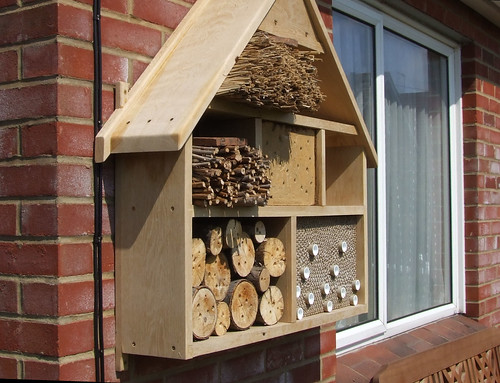
5-star hotel

The picture below was posted on the BWARS forum. This has to be the best bee hotel I've seen. If only I had a garden where I could build one of my own.

Saturday, 12 April 2008

Monomorium dakarense

I previously thought I had collected Monomorium dictator in the Gambia, as that is what this specimen keyed out as. However, I've been doing a lot of work on the salomonis-group recently and I no longer think that I was correct. I now think it is Monomorium dakarense.

It all boils down to couplet 36 of Bolton's (1987) key. I think it would be possible to debate for hours over whether the sculpture on the head of this specimen is 'uniformly densely reticulate-punctate' or 'with a silky, smeared or roughened appearance'. Initially I opted for the former because, well, it is reticulate-punctate, just more finely than the likes of Monomorium bicolor! However, I've since come to realise that this is what Bolton means by the latter, which leads to M. dakarense.

The difference between M. dakarense and M. dictator, other than the ambiguities of cephalic sculpture, seems to be size, number of ommatidia in the longest row and, importantly, scape index (SI). M. dakarense is overall the smaller of the two, with fewer ommatidia and a SI of 95-100, whereas M. dictator has a SI of 107-109. For those not familiar with SI, it is as follows:

Scape length × 100
Head width

The SI in this specimen is 92, putting it closest to the range given for M. dakarense. Given that Bolton only had the three syntype workers to measure it is likely that the true range of the SI includes 92. However, this is not the only difference between this specimen and the holotype, as the other measurements are (quoting the measurements for MJL143, followed by the range given by Bolton, in mm):

     Head length = 0.61 (0.57-0.59)
     Head width = 0.51 (0.44-0.47)
     Cephalic index (ratio of head width to height) = 84 (77-80)
     Scape length = 0.47 (0.44-0.45)
     Pronotal width = 0.31 (0.30-0.31)
     Mesosoma length = 0.72 (0.66-0.70)

Despite the larger size, the specimen is not big enough to be M. dictator and differs in the other features mentioned, so it is most likely M. dakarense.

It still remains a bit of a rediscovery. M. dakarense had been collected once in Senegal in 1914, so it's more likely than M. dictator, which had only been collected in Angola. The only specimens that I collected were found on the ground at Madiyana Camp on Jinack Island, and only at night. Since we stayed at Madiyana Camp for a few days it would be surprising if M. dakarense had been active during the day and I had not collected it then, which indicates pretty strongly that it is entirely nocturnal. Perhaps a combination of its nocturnal habits and its small size have meant that it has not been found again until now?

Sunday, 6 April 2008

Early April Additions

I've updated the links list. Highlights include 'Formicary' and 'SuperOrganism'.

Formicary is 'an aggregator for ant and other hymenopteran blogs', which basically means that it collects new additions to English ant blogs. At the moment, I do much the same using NewsFox, but this should pick up on things that I would otherwise miss. Currently it's at a temporary location, but I think it's a great idea, so hopefully it will gain permanent status.

SuperOrganism has been set up to be a more professional/academic version of The Ant Farm and Myrmecology Forum. We'll see how long it lasts.

On much the same subject, it appears as though Notes from Underground may go under because of lack of input. One wonders if this can't last, how much chance is there of SuperOrganism having a long run? Perhaps I'm being cynical: I do think that there is a need for something like this, I'm just not sure what format would be best for the target audience.

Finally, I got up unusually early (for a Sunday) and was surprised to see this out of my kitchen window.

I've seen Sparrowhawks in the centre of Thornbury before and couldn't see any jesses on this one, so I assume it was wild. I watched it for about five minutes, until someone wandered past with their dog and unwittingly disturbed it.