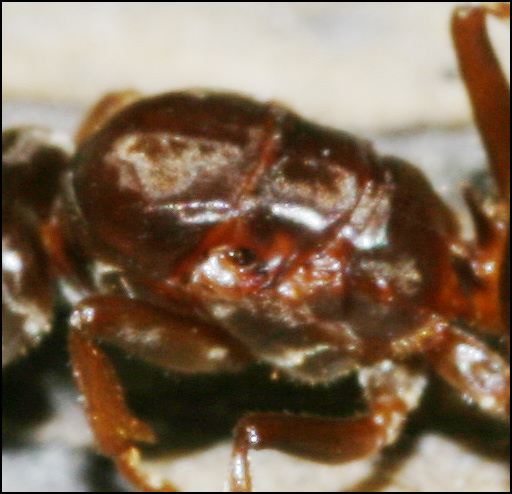
Thanks to John Pontin for pointing out the Rickia infested ant in one of this years Wildlife Photographer of the Year competition. I had the portfolio at home, but hadn't noticed the fungus on the ant. It's a bit hard to tell from the online image, but is really quite clear when it's a bit bigger.
I'm thinking that the ant is probably Myrmica rubra. As far as I know, R. wasmannii has not been recorded on this species before. Perhaps the photographer, András Mészáros, would be able to help establish whether I'm right?
I'm starting to think that R. wasmannii is actually quite common in Europe, but just under-recorded. Has anyone else made Rickia sightings?
Showing posts with label Myrmica. Show all posts
Showing posts with label Myrmica. Show all posts
Monday, 23 November 2009


Monday, 12 October 2009
Rickia wasmannii in the UK
Did anyone else notice the photograph on Plate 8 of the 'Ants of Surrey', captioned 'A rare variety of M. sabuleti with unusually shaped hairs? I'd had the book for ages and not paid any attention to it until a few weeks back. The unusually shaped hairs looked remarkably familiar to me.
I emailed John Pontin, to see if he had any specimens of these ants. After a bit of a mix-up over my address (which has changed since the last BWARS newsletter, by the way) I finally retrieved the two specimens he sent to me. They are covered with Rickia wasmannii, as I suspected, more so than the specimens I collected in Bavaria. This fulfils my ambition of finding it first in the UK, even if I didn't collect it. It also means probably two more papers to write (one for the mycologists, one for the myrmecologists).
I emailed John Pontin, to see if he had any specimens of these ants. After a bit of a mix-up over my address (which has changed since the last BWARS newsletter, by the way) I finally retrieved the two specimens he sent to me. They are covered with Rickia wasmannii, as I suspected, more so than the specimens I collected in Bavaria. This fulfils my ambition of finding it first in the UK, even if I didn't collect it. It also means probably two more papers to write (one for the mycologists, one for the myrmecologists).
Friday, 13 June 2008
Rickia wasmannii
Fairly regularly something comes along and completely stumps me, but it doesn't normally happen with European ants.
I thought I knew Myrmica well, especially M. scabrinodis, which is one of the species I most regularly encounter. This Bavarian specimen really has caused me to do a disproportionate amount of work to resolve it's identity.
 First of all I wasn't even 100% certain that it was a Myrmica. It has unusually large mandibles and, particularly, it appears to be covered with rather strange clavate hairs. I had to get my BIG eyepieces out to check the tibial spurs on the middle and hind legs (which were dubiously pectinate) and then count the palp segments, which always takes a lot of effort to get the position and lighting good enough to see anything. The result was that it is definitely a Myrmica.
By this stage I had already decided that it had the antennal scape and overall shape of M. scabrinodis, but those hairs were peculiar. I worked my mounted specimen through Seifert (1988) and his new book (2007), both of which suggested clearly that the specimen is M. scabrinodis1.
I then really started asking questions about those hairs and, once I had thought of fungi as a possibility, I quickly found was seems to be the most likely answer: Rickia wasmannii. This was described from Germany, though I've no idea how common recorded it is. It was only recently collected from Hungary and Romania (Tartally, et al, 2007), and does not appear to be known from the UK. All five specimens in this collection are covered in these little growths on almost every part of their bodies.
I haven't actually confirmed this, but I suspect that species of Rickia are host specific and that R. wasmannii is the only one that is known from Myrmica sp. However, if anyone has any additional information on Rickia sp. I'd be very grateful to hear about it. In the meantime I will spend a lot more time looking at British Myrmica in the hope that I can get the first UK record of R. wasmannii!
I sure know how to have fun on a Friday evening.
1 For those who are interested in such things, the standard measurements and indices used to make the identification were as follows:
Head length (HL) = 996 µm
Head width (HW) = 952 µm
HL/HW = 1.047
Scape length (SL) = 763 µm
SL/HL = 0.767
Minimum distance between frontal carinae (FR) = 310 µm
HW/FR = 3.071
Maximum distance between frontal lobes (FL) = 443 µm
FL/FR = 1.428
Length of propodeal spines (SP) = 310 µm
SP/HW = 0.311
Petiole width (PE) = 266 µm
PE/HW = 0.279
Postpetiole width (PP) = 376 µm
PP/HW = 0.395
I thought I knew Myrmica well, especially M. scabrinodis, which is one of the species I most regularly encounter. This Bavarian specimen really has caused me to do a disproportionate amount of work to resolve it's identity.
 First of all I wasn't even 100% certain that it was a Myrmica. It has unusually large mandibles and, particularly, it appears to be covered with rather strange clavate hairs. I had to get my BIG eyepieces out to check the tibial spurs on the middle and hind legs (which were dubiously pectinate) and then count the palp segments, which always takes a lot of effort to get the position and lighting good enough to see anything. The result was that it is definitely a Myrmica.
By this stage I had already decided that it had the antennal scape and overall shape of M. scabrinodis, but those hairs were peculiar. I worked my mounted specimen through Seifert (1988) and his new book (2007), both of which suggested clearly that the specimen is M. scabrinodis1.
I then really started asking questions about those hairs and, once I had thought of fungi as a possibility, I quickly found was seems to be the most likely answer: Rickia wasmannii. This was described from Germany, though I've no idea how common recorded it is. It was only recently collected from Hungary and Romania (Tartally, et al, 2007), and does not appear to be known from the UK. All five specimens in this collection are covered in these little growths on almost every part of their bodies.
I haven't actually confirmed this, but I suspect that species of Rickia are host specific and that R. wasmannii is the only one that is known from Myrmica sp. However, if anyone has any additional information on Rickia sp. I'd be very grateful to hear about it. In the meantime I will spend a lot more time looking at British Myrmica in the hope that I can get the first UK record of R. wasmannii!
I sure know how to have fun on a Friday evening.
1 For those who are interested in such things, the standard measurements and indices used to make the identification were as follows:
Head length (HL) = 996 µm
Head width (HW) = 952 µm
HL/HW = 1.047
Scape length (SL) = 763 µm
SL/HL = 0.767
Minimum distance between frontal carinae (FR) = 310 µm
HW/FR = 3.071
Maximum distance between frontal lobes (FL) = 443 µm
FL/FR = 1.428
Length of propodeal spines (SP) = 310 µm
SP/HW = 0.311
Petiole width (PE) = 266 µm
PE/HW = 0.279
Postpetiole width (PP) = 376 µm
PP/HW = 0.395
Wednesday, 2 January 2008
Oddities
The latter few months of 2007 seemed bring encounters with an unusual number of freak ant specimens, unfortunately none of which were collected by me.
First, an ant with a third eye, a Myrmica as I recall, was brought to the BWARS workshops in September. At least, it appeared to be like a third eye. It was a black area that was partially buried in the cuticle of the head, but where it came to the surface it did have a bobbly appearance like that of a compound eye.
The ant presumably used the eye for seeing into the future.
Then before Christmas I looked properly at a specimen lent to me by Cedric Collingwood some months ago. He knew that I was working on the ants of The Gambia and had a few specimens in his collection. This specimen had been collected by Nicolas Blacker and identified by Cedric as Camponotus vividus, but it was unlike any of the specimens I had collected. I finally got around to identifying all the Camponotus I collected in the Gambia and discovered that I did have C. vividus, so needed to check why Cedric's were different. To my surprise I discovered that the specimen is actually a pseudogyne (between a queen and a worker). It is larger, paler and more matt, with a more developed mesosoma and one pair of barely developed tiny 'wings'. It may be the only pseudogyne of that species in any collection.
Finally, right at the end of 2007, C-G Magnusson posted some photos of an ant for ID to the BWARS discussion group. It was agreed that it looked most like a queen of a Camponotus... or a Lasius, but it had a very unusual shaped petiole, being so deeply emarginate that it had two erect blunt spines there instead.
First, an ant with a third eye, a Myrmica as I recall, was brought to the BWARS workshops in September. At least, it appeared to be like a third eye. It was a black area that was partially buried in the cuticle of the head, but where it came to the surface it did have a bobbly appearance like that of a compound eye.
The ant presumably used the eye for seeing into the future.
Then before Christmas I looked properly at a specimen lent to me by Cedric Collingwood some months ago. He knew that I was working on the ants of The Gambia and had a few specimens in his collection. This specimen had been collected by Nicolas Blacker and identified by Cedric as Camponotus vividus, but it was unlike any of the specimens I had collected. I finally got around to identifying all the Camponotus I collected in the Gambia and discovered that I did have C. vividus, so needed to check why Cedric's were different. To my surprise I discovered that the specimen is actually a pseudogyne (between a queen and a worker). It is larger, paler and more matt, with a more developed mesosoma and one pair of barely developed tiny 'wings'. It may be the only pseudogyne of that species in any collection.
Finally, right at the end of 2007, C-G Magnusson posted some photos of an ant for ID to the BWARS discussion group. It was agreed that it looked most like a queen of a Camponotus... or a Lasius, but it had a very unusual shaped petiole, being so deeply emarginate that it had two erect blunt spines there instead.
Subscribe to:
Posts (Atom)

 Posts
Posts