Showing posts with label Camponotus. Show all posts

Tuesday, 25 March 2008

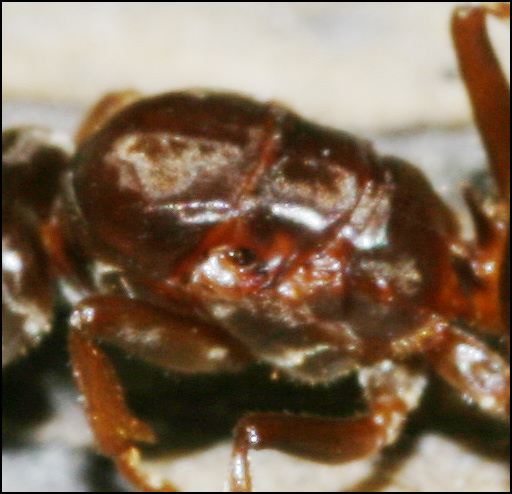
Camponotus vestitus subsp. intuens

I originally identified this as Camponotus cosmicus and wrote a nice long blog defending my decision to call it that. I even provisionally synonomised it with a few other species and subspecies. I was wrong!

At the time, I sent photographs to Brian Taylor, who replied, 'Why do you not think this is Camponotus vestitus?' Perhaps I should have recognised that his far greater experience was likely to lead to a correct identification, but I like to learn from my own mistakes.

C. cosmicus was one of the species that I checked when I visited the London Natural History Museum, as the holotype is there. C. cosmicus is a large and fairly stocky ant, even the minors, unlike my specimens. I was also able to check C. vestitus subsp. pectitus, which has all the right features (divergent pubescence on the gaster, same number of setae on the mesosoma, same propodeum shape) and differs only slightly in the colour of the head.

Arnold (1924) stated that Smith's (1858) description of C. cosmicus is useless, and it appears as though he is right. However, none of the authors who have written about C. cosmicus picked up on what I believe is probably the most significant characteristic, as all specimens in the museum had many erect setae on the ventral surface of the head. I can also add that C. cosmicus is predominantly very dark red (not black), with the propodeum rounding smoothly from the metanotal groove, less divergent pubescence on the gaster and a greater number of setae on the mesosoma.

So, maybe it is C. vestitus subsp. pectitus. It gets complicated because Bolton (1995) states that Santschi (1926) suggested that C. vestitus subsp. pectitus and C. vestitus subsp. intuens are the same, but at no point do they appear to have been properly synonymised. Reading Santschi's statement, it seems pretty clear that he has no doubt, so I can only assume that Bolton did not synonymise it because the description of C. vestitus subsp. pectitus post dates this statement! Forel's (1909) description of C. vestitus subsp. intuens is just as ambiguous as the descriptions of C. cosmicus and C. vestitus subsp. pectitus.

Update Nov 2008: My specimens have now been compared with the type specimens from the Naturhistorisches Museum Basel. This allowed me to confirm that they are very clearly C. vestitus subsp. intuens - a completely identical match. Possibly the colour of the head is the key feature in discriminating these subspecies.

I also showed my specimens to Cedric Collingwood, who claimed them to be C. jizani. This is a species from the Middle East, though he admitted that the only reason he named it thus was because he didn't know what else to call it! Possibly, C. jizani is a junior synonym of C. vestitus subsp. intuens or C. vestitus.

This species was collected a number of times only in the grounds of the hotel we were staying at in Kololi, Gambia. Here it could be found nesting in turret nests, so named because there were steep 'craters' of sand piled around the nest entrances, up to about an inch high. These are described by Arnold (op. cit.) for C. vestitus subsp. pectitus, which he states is rare and found nesting in sandy soils. He then describes,
'nest-entrances[s] surrounded by a circular, high and sharp-edged crater... This form of crater is distinctive of this insect.'

Corrections

Before I disappeared for Easter I visited the London Natural History Museum to compare my some of my Gambian specimens with ant specimens in their collection. As a result, I have a few changes to make, but need to do a bit more work before I make them. Until I change the posts, this will hopefully caution against relying on previous posts.

I had misidentified the following species:
I had correctly identified these species:
These species are perhaps open to debate, as I couldn't conclusively establish whether they were the same species or different:
  • Camponotus rufoglaucus controversus - slight differences in setae and pubescence but the specimens checked were not types and were majors only.
  • Camponotus olivieri lemma and delagoensis - I couldn't check these subspecies.
  • Crematogaster impressa - the specimens present were collected by Donisthorpe and did not appear to be the same as mine or each other. Chances are this species and C. excisa will not be resolved until the taxonomy is revised.

Saturday, 26 January 2008

Camponotus olivieri

Camponotus olivieri is a widespread species in Africa, ranging from South Africa north to Sudan and west to Ghana. However, it is made up of a great many subspecies that probably deserve species status, so the situation may be rather more complicated than it seems at first.

Two subspecies of C. olivieri were collected in The Gambia: lemma and delagoensis. They differ quite markedly in pubescence and also, to a lesser extent, morphology. What I think provides some evidence that they deserve separate status is that they were both found at one site.

C. olivieri subsp. lemma was found in two locations: Abuko National Park, Lamin and Bijilo Forest Park, Kololi. In both cases it was found only on the ground. It can be distinguished from other species of C. olivieri by the rust colour at the base of the antennal scapes and the gaster, which is uniformly shiny, sparsely pubescent but still more densely pubescent than the mesosoma and has erect hairs that are thicker than the pubescence.

C. olivieri subsp. delagoensis was found at Abuko National Park, on a tree. It is similar to subsp. lemma, but has denser, yellow pubescence, especially on the gaster.

Both ants have been recorded only rarely, possibly due to the fact that they are regarded as subspecies and so have been more frequently recorded at species level. C. olivieri subsp. lemma had been recorded in Angola, Tanzania and former Zaire. C. olivieri subsp. delagoensis was only known from the type location at Delagoa Bay in Mozambique. This makes these Gambian records an extension of the known range of the species and both subspecies, especially large in the case of subsp. delagoensis.

These have both been compared with the type specimens from the Muséum d'histoire naturelle, Genève and the Naturhistorisches Museum Basel. This allowed me to confirm C. olivieri subsp. delagoenisis.

The syntypes of C. olivieri subsp. lemma are rather variably hairy, so much so that I wondered if Forel had mounted specimens from different colonies on the same pins. The main difference between these and my specimens was that most of the types were much less hairy, though one was similar to mine. It could be that the specimens have lost some of their pilosity. Regardless, I feel I need to do some more work to confirm that there is nothing closer.

Wednesday, 2 January 2008

Oddities

The latter few months of 2007 seemed bring encounters with an unusual number of freak ant specimens, unfortunately none of which were collected by me.

First, an ant with a third eye, a Myrmica as I recall, was brought to the BWARS workshops in September. At least, it appeared to be like a third eye. It was a black area that was partially buried in the cuticle of the head, but where it came to the surface it did have a bobbly appearance like that of a compound eye.

The ant presumably used the eye for seeing into the future.

Then before Christmas I looked properly at a specimen lent to me by Cedric Collingwood some months ago. He knew that I was working on the ants of The Gambia and had a few specimens in his collection. This specimen had been collected by Nicolas Blacker and identified by Cedric as Camponotus vividus, but it was unlike any of the specimens I had collected. I finally got around to identifying all the Camponotus I collected in the Gambia and discovered that I did have C. vividus, so needed to check why Cedric's were different. To my surprise I discovered that the specimen is actually a pseudogyne (between a queen and a worker). It is larger, paler and more matt, with a more developed mesosoma and one pair of barely developed tiny 'wings'. It may be the only pseudogyne of that species in any collection.

Finally, right at the end of 2007, C-G Magnusson posted some photos of an ant for ID to the BWARS discussion group. It was agreed that it looked most like a queen of a Camponotus... or a Lasius, but it had a very unusual shaped petiole, being so deeply emarginate that it had two erect blunt spines there instead.